

Last fall I was sitting in the hot seat of a mastermind session when the leader, Josh Linkner, asked a question that supercharged my thinking about the Power of &™.
“Matt, why do I need the Power of &?“
A great question that stopped me in my tracks.
Josh wanted to know, in the simplest terms, what a leader actually gains by refusing the either/or trap. Growth or discipline. People or performance. This quarter or the long haul.
I’ve written a whole book on the idea that the best leaders manage those tensions instead of picking a side. But sitting across from Josh, I realized conviction wasn’t going to cut it. He wanted proof. Here’s the answer I wish I’d had in the room.
First, a quick recap
Last time we talked about the Capacity Gap: the way constant overload wears us down and drives us toward the kind of black-and-white thinking that prevents us from harnessing the Power of &. Closing that gap is the critical first step in the process, but it is never the finish line.
Capacity is what gets us into the game. The Power of & is the tool we use to win once we’re in the arena. The payoff turns out to be bigger than I first imagined, and it’s been hiding in plain sight for a long time.
The evidence

Start with Jim Collins. Back in the ‘90s, in Built to Last, he found that the companies built on what he called the “Genius of the AND” outperformed the broader market by something like 15x over six decades. People have poked at his methods since, so I don’t hang the whole case on him. He’s just a good place to begin, because everything after him points in the same direction.
Take the long game. When McKinsey’s researchers followed hundreds of big U.S. companies across 14 years, the ones that refused to sacrifice tomorrow for this quarter grew faster, earned more, and created more value than the crowd chasing the short term. Working both horizons at once paid off, to the tune of nearly 50% more revenue growth and 80% more economic profit growth.
Or take purpose. In Firms of Endearment, Raj Sisodia and his colleagues tracked companies that genuinely tried to serve every stakeholder in their orbit: customers, employees, investors, and the community. Over 15 years, those companies beat the S&P 500 by roughly 14x. Doing well and doing right weren’t fighting each other. They were feeding each other.
The studies come from different researchers and different decades, and they keep arriving at the same answer.
The rarest skill in the C-suite
Here’s the one that stopped me. Throughout my career, I noticed the most successful clients and managers were the ones who consistently found the &. I knew this skill was rare, but I didn’t know how rare.
Korn Ferry found the answer. They set out to find what separates the CEOs who create real value from everyone else. The winners shared a single trait: they could run the business and change the business at the same time. Keep today’s engine humming while building tomorrow’s. And they created far more value for it.
But here’s the catch: fewer than 14% of executives can actually do this.
One in seven leaders can actually run the business and change the business simultaneously. This is the most valuable skill a leader can carry, and most of us haven’t built it yet.
I don’t read that as bad news. I read it as the reason to write my book. Nobody is born with the ability to operate and reinvent at once. It’s a skill, which means it can be learned. Move that number even a little, and that’s a lot of leaders, and a lot of organizations, that get better.
None of it works without trust
Here’s a key insight. We can’t find the & on a team that’s afraid to tell us the truth.
Google went searching for what makes its best teams tick, expecting the secret to sit with the skill level of the team. What it found was simpler. The best teams were the ones where people felt safe to speak up. Alan Mulally had built the same thing into Ford’s turnaround years earlier, when he made it safe for his people to say “this isn’t working.” Honesty in the room is what lets a team weigh both sides of a hard call instead of just defending one.
And when the pressure is on to change, the leaders who bring their people along, rather than dragging results forward and leaving everyone else behind, are far likelier to make the change stick. EY and Oxford put a number on it: more than 2.5x likelier.
The final answer
The companies that harness the Power of & outperform and outlast the ones that don’t. The leaders who master it are rare, and the market pays them for it. All of it rests on teams that trust each other enough to be honest. And all these skills can be built if we recapture the capacity to learn them.
That’s the why.
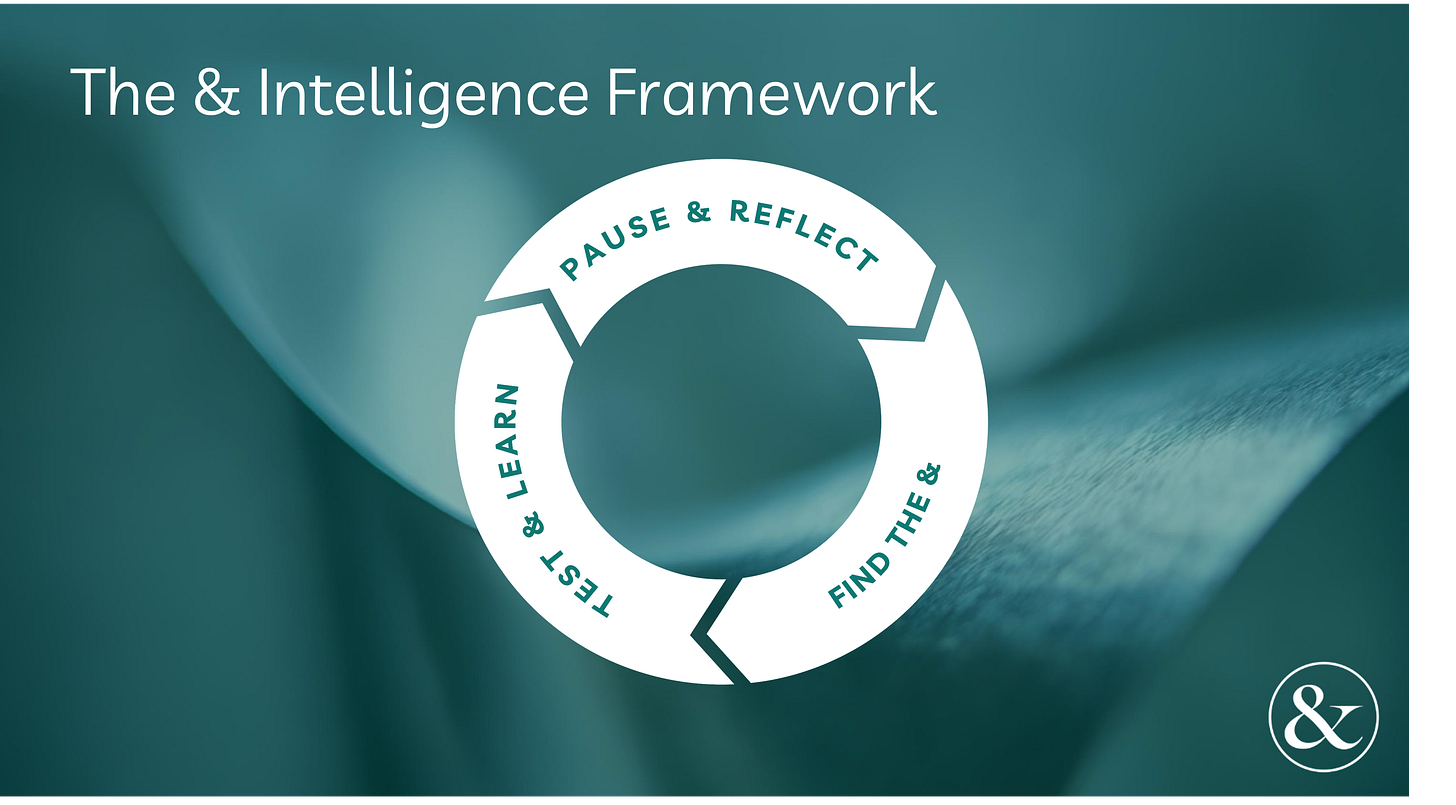
The how is a framework I call & Intelligence™, and it comes down to three moves: Pause & Reflect, Find the &, and Test & Learn. We’ll spend the next few weeks walking through each one.
For now, I’ll leave you where Josh left me.
Where in your own leadership are you settling for “or,” when the real win is in the “&”?
- MBE
Sources
Collins 15x: Collins & Porras, Built to Last (1994); jimcollins.com. $1 (1926) → $6,356 by 1990 vs. $415 general market.
Long-term firms: McKinsey Global Institute & FCLTGlobal, “Measuring the Economic Impact of Short-Termism,” 2017. 615 firms, 2001–2015: revenue +47%, earnings +36%, economic profit +81% vs. peers; ~$7B more market cap each.
Firms of Endearment: Sisodia, Sheth & Wolfe, Firms of Endearment, 2nd ed. (2014). 14:1 vs. S&P 500 over 15 years (1998–2013).
CEO enterprise leadership / 14%: Korn Ferry Institute, “Unlocking CEO Success,” March 2024 (100+ public companies). Perform-and-transform CEOs: +109% annualized market-cap growth over 4 yrs, +20% revenue growth, +26% EBITDA margins; fewer than 14% of executives qualify.
Psychological safety: Google re:Work, Project Aristotle; Duhigg, NYT Magazine, 2016. 180 teams; psychological safety the top of five dynamics; high-safety teams rated effective twice as often by executives.
Human-centered change: EY & Saïd Business School, University of Oxford, 2021–22. 935 senior leaders + 1,127 workers, 23 countries: results-and-people transformations 2.6x more likely to succeed; emotional strain +136% in underperforming transformations.