

Last week, I shared a conversation with a former teammate who now works at another large bank. Her leadership team asked employees to use Copilot at least three times a week. She and her colleagues followed the directions. Usage increased, costs rose, and about a month later, the message pivoted: use AI judiciously.
She was frustrated at the change in direction from her leadership, and many of us know the feeling. Asking “And then what?” might have helped her leadership anticipate the consequences. Following that question far enough requires more from us than we realize.
We face legitimate demands all the time, like increasing AI adoption while controlling costs, moving quickly while protecting quality, and delivering today while preparing for tomorrow. Naming both competing priorities is the first step in balancing them. Then comes the hard work of integration.
The Power of & sounds great, but it fails when we treat it as merely a slogan. When we ask our teammates to manage competing tensions, we also need to create room to examine the demands, speak candidly about them and learn how to attack the challenge.
Last week, we explored how capacity deficits keep us from asking, “And then what?” This week, I examine how we create three critical foundations to help us develop a stronger answer: capacity, candor and learning.
Capacity: time and space to examine the full problem
We can have an hour available and still struggle to give a consequential decision the attention it deserves. Our calendar may show an opening while our minds carry unfinished conversations, urgent requests and decisions we haven’t resolved.
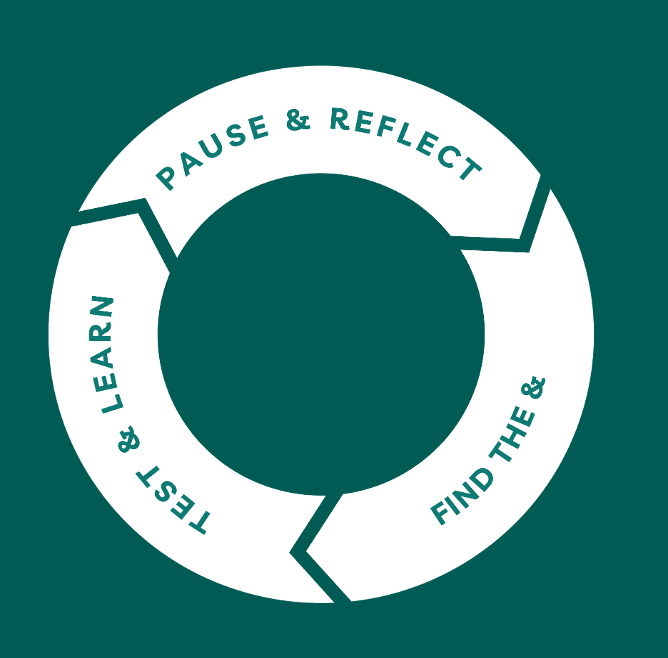
The first move of the & Intelligence™ framework, Pause & Reflect, creates capacity as we step back from immediate demands and decide what deserves our attention. We separate the important from the merely urgent, identify what we can control and make room to examine downstream consequences. That powerful pause creates the capacity to consider multiple true priorities before choosing an answer. Through that process, we gain clarity.
The authors of Deliberate Calm describe how pressure can draw us toward familiar responses precisely when unfamiliar circumstances require us to adapt. Their work helps explain why a pause matters.
For AI adoption, that pause gives us room to consider value, quality, costs and the attention we will spend reviewing the output. We can examine the full problem before a usage target becomes our answer.
Candor: getting real and building trust
We each see a different part of the work. Some of us understand the customer opportunity; others see the costs or the effort required to review the output. We need one another’s experience to understand the full problem and see the opportunities it may hold.
In the second move, Find the &, we define shared success by examining what matters to each of us. We listen for possibility, explain the interests behind our positions and make room for concerns that complicate the answer we’d like to hear. That conversation reveals both competing and common interests.
As we see one another take those interests seriously, we build trust in the process and in each other. We become more willing to challenge assumptions, acknowledge uncertainty and surface inconvenient facts. That is how Find the & creates candor and strengthens our connection to a shared definition of success.
Amy Edmondson’s research found an association between psychological safety and team learning. We need enough confidence in how we will respond to one another to bring difficult information into the conversation.
Learning: discovering what works
Even after a thoughtful discussion, we will still have assumptions to test.
The final move, Test & Learn, creates learning as we turn an assumption into a bounded experiment, examine the result and adjust our next decision. We define what we want to learn, give ourselves authority to act within clear limits and protect time to review what happened. We can then test a better answer while continuing to perform our daily work.
In my former teammate’s case, one approach would be to test an AI workflow on a defined assignment or with a small team, then examine the quality, cost and total effort required to produce a usable result. We would learn more about its value before extending it across the organization.
What is so useful about this step is that the work itself becomes our lab. As we compare what we expected with what happened, we improve our judgment and build courage to lean into the changes that learning inevitably drives.
How the foundations work together
Let’s return to the tension between AI adoption and cost.
Pause & Reflect gives us capacity to examine what increased usage will set in motion. Find the & creates candor about the benefits we’re looking for, the costs we must manage and our common interest in creating value. Test & Learn helps us discover which ideas and changes move us towards our shared definition of success.
We need all three. Without capacity, we rush past consequences we should examine. Without candor, we leave important concerns unaddressed. Without learning, we commit to an answer before testing whether it works.
Sustaining the conditions under pressure
Under sustained load, we may shorten discussions, hear fewer perspectives and postpone experiments to protect immediate delivery. When assumptions go unchallenged, we can create further problems and add to the load.
Jim Collins’s Level 5 leadership pairs personal humility with professional will. That pairing helps here. Humility keeps us open to evidence and a better answer. Will keeps us accountable for results and persistently present through challenges.
We need both as we continue the practice, especially when pressure makes a familiar either/or response tempting.
Capacity, candor and learning are foundational because integrating competing priorities requires us to understand the full problem, reconcile the interests involved and discover an answer that works. Capacity gives us the time and attention to create clarity. Candor brings our experience and concerns into the conversation, building trust and connection as we define shared success. Learning helps us test whether our answer delivers what we intended and adjust when it falls short. As we learn how to improve the answer, we build courage to lean into change.
Through consistent practice of & Intelligence, we create and renew those conditions. That practice drives the Capacity Advantage: we recapture capacity to exercise judgment, coordinate our efforts and adapt while delivering on our commitments.
So here is the question I am sitting with this week: where could we pause, bring competing and common interests into the open, and test a better answer to a tension our team keeps carrying?
Sources
Capacity and judgment
Jacqueline Brassey, Aaron De Smet and Michiel Kruyt, “Deliberate Calm: How to Learn and Lead in a Volatile World,” McKinsey.
Candor and learning
Amy Edmondson, “Psychological Safety and Learning Behavior in Work Teams,” Administrative Science Quarterly 44, no. 2 (1999): 350–383.
Humility and will
Jim Collins, “Level 5 Leadership.”