
I gave a talk this morning and, as I typically do, shared my own story of carrying too much. What happened next is becoming increasingly common. Someone came up quietly afterward to tell me their overload story.
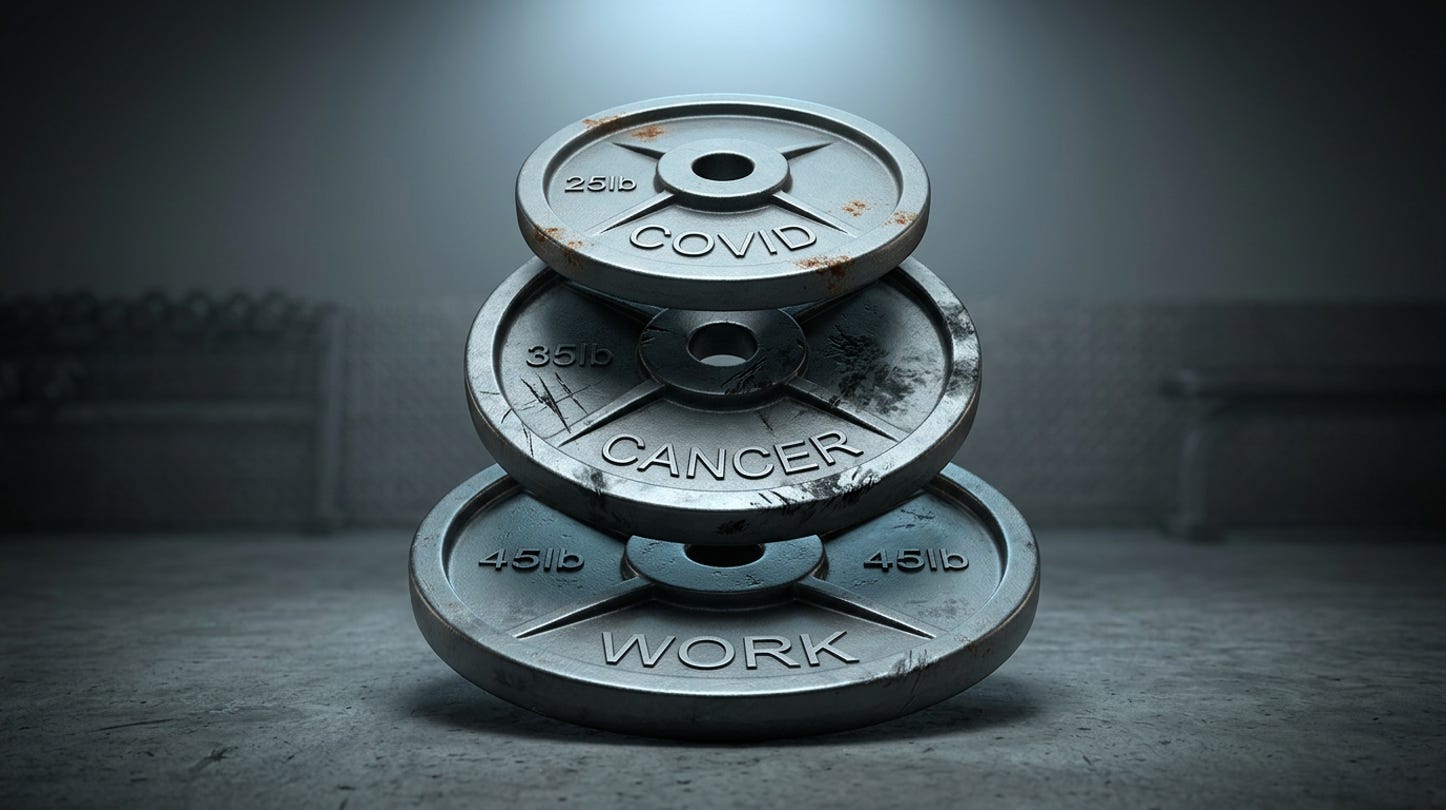
This time it was a senior financial executive. He said the image I use had stayed with him: the weights of work, cancer, and COVID, stacked one on top of another until the load is more than any of us was built to carry. For him, it was the cancer weight that pressed down hardest, but the bigger point he was making is that we all carry load that, over time, can be unbearable.
The question now is how much more any of us can be asked to carry.
Here is the gap we are all living inside. According to Microsoft’s 2025 Work Trend Index, 53% of leaders say productivity has to increase. But at the same time, 80% of the global workforce, leaders included, say they no longer have the time or energy to do the job in front of them.1
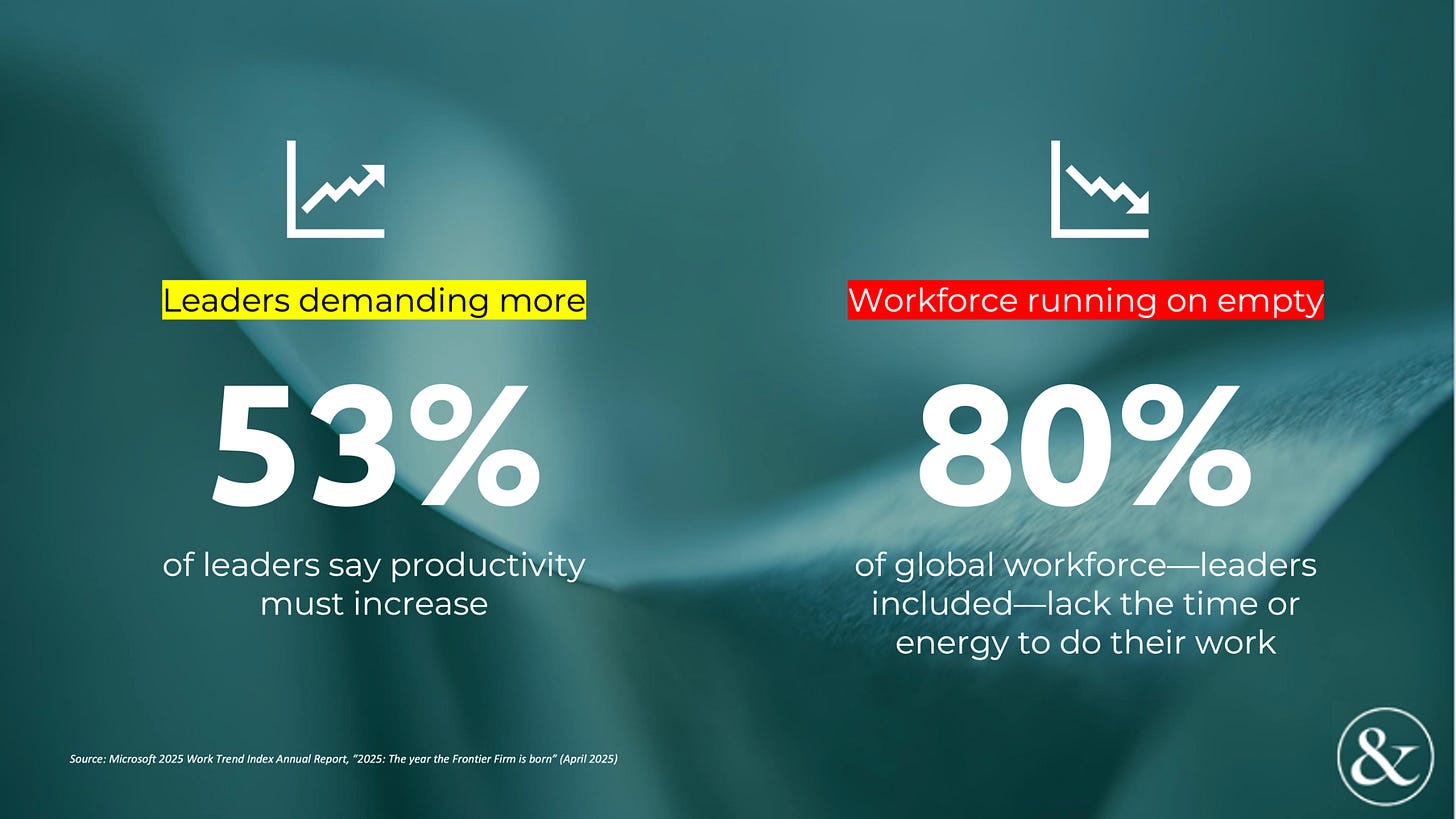
I call it the capacity gap: the space between what we are asked to produce and what we have left to give. The wider it grows, the larger the bill.
And the bill is already enormous. According to a Stanford and Harvard study in Management Science, workplace stress is associated with more than 120,000 U.S. deaths a year (in line with Alzheimer’s) and 5 to 8% of national healthcare spending.2 I have to remind myself those numbers are people, not line items.
Along the way, we have made exhaustion the price of ambition. A little over a year ago, a Fortune 500 CEO told me there were about 20minutes in his day when he wasn’t thinking about work. Twenty minutes. He said it like a confession. I have never forgotten it, because most of the leaders I meet would recognize the math. It’s little wonder then that, according to Deloitte, nearly 70% of the C-suite has seriously considered walking away for a role that would protect their well-being.3
This is why binary thinking has become so pervasive. When the load runs this high, the brain looks for relief. It narrows the options. It collapses hard questions into fast either/or choices. Performance or people. Speed or quality. I write about binary thinking a lot, but it’s important to remember either/or is not a character flaw. It is what capable people do when too much is coming at them and too little is left in reserve.
This is why the message of Overloaded keeps landing. We are not debating whether leaders are overwhelmed. We all know we are. We are looking for a path forward that doesn’t ask us to choose between winning and surviving.
That way through starts with capacity. Capacity is the prerequisite. Before we can harness the Power of &™, the better answer–one that honors competing priorities instead of trading them off–we have to recapture the room to think at all.
That is the work of & Intelligence™: Pause & Reflect, Find the &, and Test & Learn. Three moves that pull us out of the binary trap and back into judgment. They protect the thing overload steals first, which is our ability to focus on what matters and who matters most.
My new executive friend paid a high price for the lesson. The rest of us don’t have to.
We can recapture the capacity to deliver and win. And we can do it without burning out the people who make winning possible.
What would change for you if we closed even part of that gap?
1https://www.microsoft.com/en-us/worklab/work-trend-index/breaking-down-infinite-workday
2https://pubsonline.informs.org/doi/10.1287/mnsc.2014.2115.
3https://www.deloitte.com/us/en/insights/topics/leadership/employee-wellness-in-the-corporate-workplace.html