

When I speak to a group, the line audiences repeat back to me is not the one I worked hardest on.
It’s seven words: “I can do anything, but not everything.”
People say it to me in the hallway after a keynote. They write it on a napkin. They send it to me months later at 11 p.m. with no other message attached.
And then someone comes up to me and asks the money question. “That sounds great, but what if my boss doesn’t know that?”
They’re right. I never picked my scope of work either. Three executive roles at once. Scorecards with seemingly endless columns. A policy conference to lead. Every demand came from a real person with a real consequence attached, and none of them asked me first if I had room on my calendar.
So let’s be precise about what the line means. It describes timing. We can hold a large scope, and yet we have to recognize we can’t hold every piece of it in the same week or the same day.
The false choice underneath
Last week we noted that accelerating change produces sustained load. Sustained load erodes capacity. A leader running short on capacity starts thinking in black and white, or binaries, which impairs performance.
This response is hard-wired into our physiology, and it happens to capable people operating under conditions that would narrow anyone’s thinking into false choices.
Mine sounded like this: either I carry all of it, or I’m failing.
Both options are all-or-nothing losers. The Power of &™ gives us a third option. We can accept the full scope and control the sequence.
Scope usually belongs to someone else. Sequence belongs to us. Most weeks, that is the only thing we can control.
Here’s what it looks like to sort through the mess and clarify what matters most.
Move one: Pause & Reflect
Sorting starts with stopping.
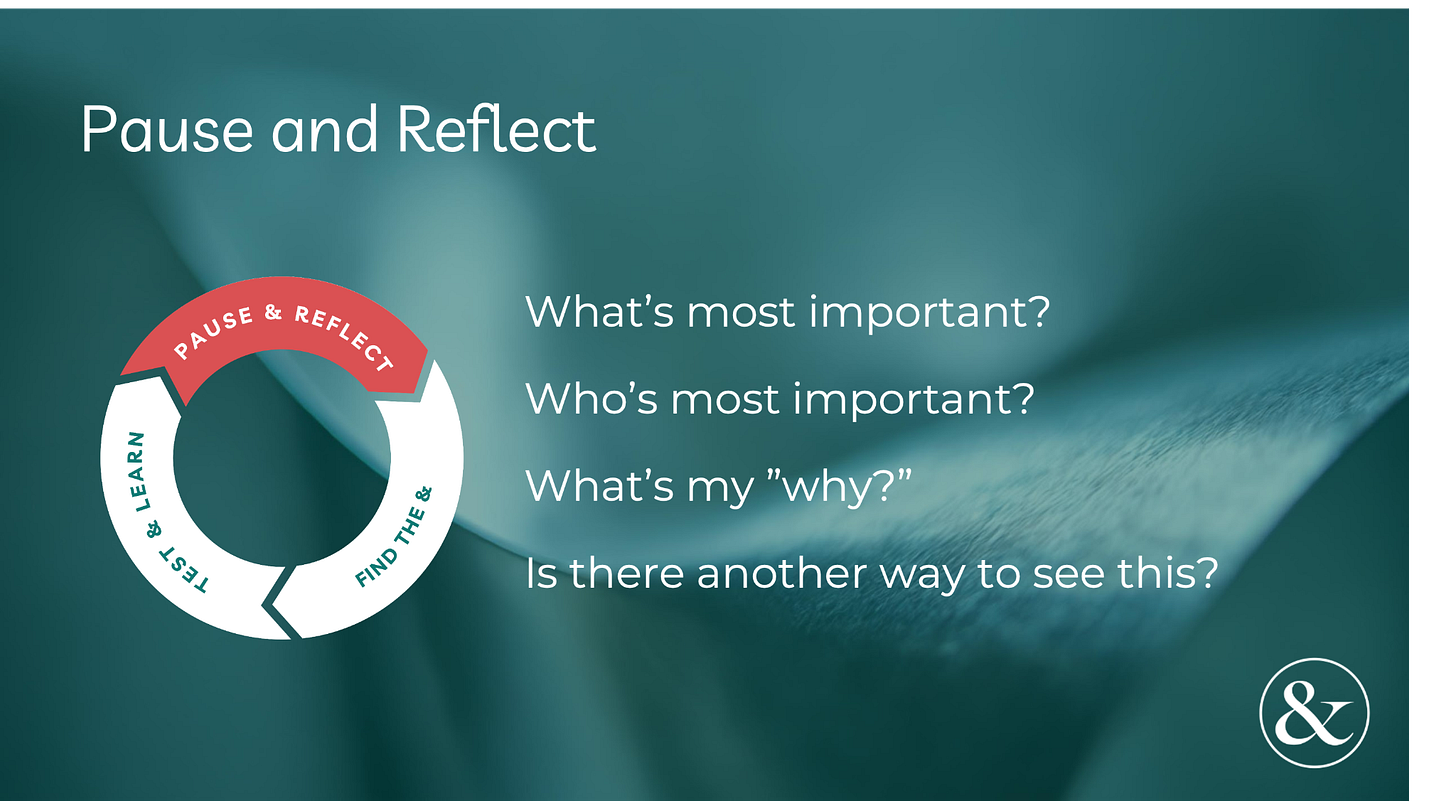
Four questions do the work:
What’s most important?
Who’s most important?
What’s my “why?”
Is there another way to see this?
They separate urgency from importance, and they connect the week’s work to our key priorities.
I’ve run a version of this for 30 years. I keep a Franklin Planner. Each year I write down my roles and my priorities. Each month, I choose the “rocks” I need to achieve, and each week I plan around them before anything else touches the calendar. For example, when my son pitched in high school, the days he was going to be on the mound went on the calendar first.
Under stress, we default to whatever system we built while we were calm, but the planner puts the pause on our schedules, so we’re better able to choose how we use our time.
Move two: Sort the load
Dwight Eisenhower observed that the urgent and the important rarely overlap. Covey turned that observation into a 2x2 grid 35 years later in The 7 Habits of Highly Effective People. Eisenhower's name stuck. The tool is Covey's.
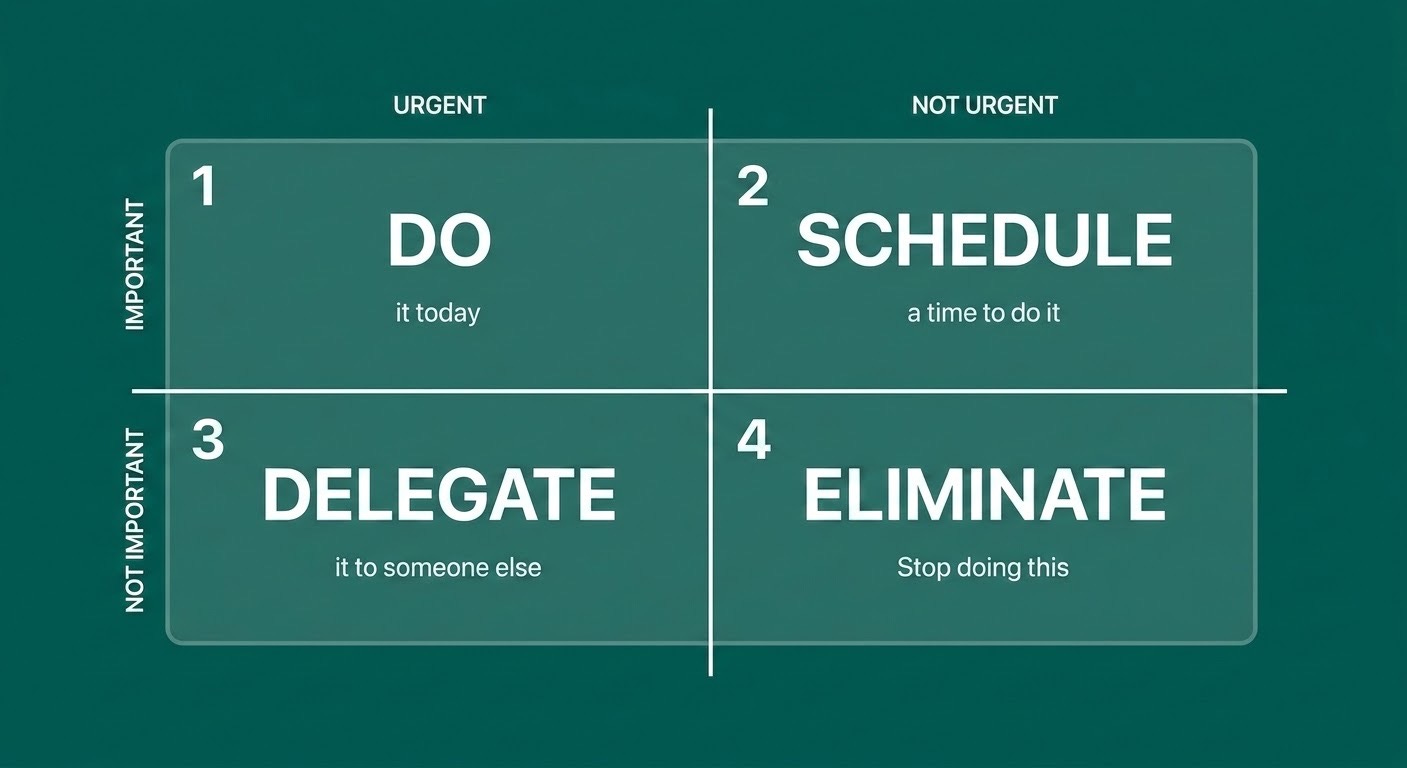
Four boxes. Four verbs.
Quadrant 1: Urgent and important. Do it now.
Quadrant 2: Important, not urgent. Schedule it.
Quadrant 3: Urgent, not important. Delegate it.
Quadrant 4: Neither. Eliminate it.
The leadership challenge sits in the top two boxes.
The work we do in Quadrant 2 compounds. Planning, relationships, prevention. Nothing in that box has a near-term deadline chasing it, which is exactly why it tends to be displaced every week in favor of what our brains tell us is urgent.
Quadrant 3 is where that time typically goes. Urgent work that isn’t important feels identical to Quadrant 1. When we’re overloaded, Quadrant 3 tasks carry the same adrenaline and same certainty that they cannot wait.
Covey warned that a career spent inside Quadrant 1 produces stress and burnout. I can confirm that diagnosis. Similarly, spending too much time in Quadrant 3 limits our effectiveness.
One caution. The matrix answers what’s most important. It says nothing about who’s most important, or why any of it matters. Sorting an unexamined list is efficient and also useless. So we pause first and sort second.
Move three: Build the system
Now we focus on the work that survives the sort. Some of it we carry. Some of it we hand off. But to whom?
AI is the obvious candidate and the obvious trap. Ideally, there should be a big chunk of Quadrant 3 that we should hand off to AI. And if we’re careful, we can.
But first, the trap. In 2024, Upwork found that 77% of employees using AI said the tools had added to their workload. They spent more time reviewing AI output (39%), more time learning the tools (23%), and more time on work handed to them because AI was supposed to create room for it (21%). Nearly half had no idea how to produce the gains their employers expected.
A tool dropped into an overloaded system multiplies the load. Three rules prevent that:
Hand off what’s easy to specify. Anthropic’s research into how people actually use AI finds that the tasks requiring the least autonomy are the ones that are simplest to describe. Translation. Calculation. Direct questions with direct answers. Work that requires choosing among many possible right answers still needs a person deciding. Clean Quadrant 3 tasks qualify. Ambiguous ones don’t.
Keep what requires judgment and trust. Anthropic surveyed roughly 9,700 users. The most experienced among them, 15 years in or more, named judgment, contextual awareness, and situational reasoning as what AI lacks. They pointed to building trust and managing people as work it cannot replicate. That’s the boundary. Anything in Quadrant 1 with a human being on the other side stays with us.
Start simple. Anthropic’s own engineering guidance is to find the simplest solution that works and add complexity only when the work demands it. AI delivers most where success is clearly defined, feedback comes fast, and a person reviews the output. Any leader can run that test. It’s the same test we run before handing a project to a new team member.
And one warning. Automating Quadrant 4 makes it permanent. Delete it instead, no matter how juicy the conversation or intellectually interesting the subject line of the email.
The week we actually have
We can do anything. We can’t do everything. But most of us can’t shrink the list.
But here’s what we can do: We can stop long enough to see it, we can put every item in one of four boxes, and we can build a system to carry what’s left.
That’s the Capacity Advantage, and it compounds.
So here’s the question I’m sitting with this week: what’s in my Quadrant 1 that has no business being there?