

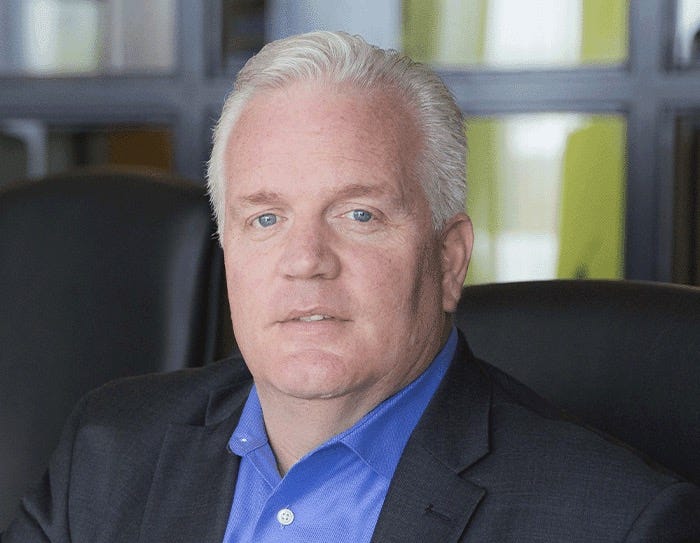
Just before the 2025 Mackinac Policy Conference, MichAuto, Michigan’s premier advocate for the auto supplier industry, hosted a panel of CEOs who were navigating accelerating change. I had the pleasure of moderating. Suppliers spend their days running plants to serve the market as it currently exists while rebuilding their companies for the one that hasn’t arrived yet. Nobody on that stage had the option of doing one and skipping the other.
Turns out that combination isn’t an automotive problem. It’s the & that every leadership team I work with is carrying: execute today & evolve for the future.
Last week we looked at the Visionary and the Integrator, and how that pair now has to share the view instead of dividing the work. The pair can set the flight path, but the team still has to be willing and able to fly it.
The & on everyone’s plate
Korn Ferry frames the modern chief executive’s central challenge as running the business and changing it at the same time. The CEOs who score highest on its assessment go on to create a little more than double the market value of the ones who score lowest.
The structural evidence is older and blunter. O’Reilly and Tushman studied companies attempting breakthrough innovation. The ones that built structures to hold innovations alongside the existing business almost always got where they were going. The ones that pushed new elements through the existing structure rarely did.
The lesson? Strategy is rarely the constraint. Readiness is.
Listen to the first word
Here is the cheapest diagnostic I know. Bring a team something genuinely new and listen to the word that comes back first.
“But — that’s not how we do it here.” Not ready.
“How might we?” Ready.
No survey, no offsite, no diagnostic instrument. One word, and it arrives before anyone has had time to be political about it.
The CEO who waited
One of the CEOs on the panel ran a family-owned Tier 1 supplier. The family hired him to scale it, largely through acquisition, because they knew the company had to grow to compete in its space and stay relevant to its OEM clients.
The CEO brought the first targets to his leadership team and ran into a wall of but. “That’s not how we do things around here.”
So he went back to his board and told them his team wasn’t ready.
Boards that hear this usually want a date. He offered a word instead. He would know his team was ready when he heard how. It is an unusual thing to say to the people who hired you to move quickly, and he said it anyway.
He spent the following months doing two things: building the business case for change, and making it safe to entertain. Some months later, the word changed. The company went on to more than double in size through acquisition.
Why “but” turns up
But isn’t obstruction. It’s what overload produces in people and teams. Under sustained load, the brain reaches for the fast, familiar, either/or pattern at exactly the moment the situation calls for integration. Status quo feels safe, and change feels dangerous.
Safety determines whether experimentation is even available. Google re:work studied its own teams and found the ones where people felt safe speaking up were rated effective twice as often as those in which speaking up was seen as risky. Our CEO didn’t wait for his team to change temperament. He changed the perceived riskiness of change by establishing the high cost of maintaining business-as-usual and demonstrating the value of growth to the team itself.
Getting to how
That’s the work of the Power of &™, and the three moves of & Intelligence™ are how we run it.
Pause & Reflect. Narrow to the few priorities that genuinely matter. We can do anything, but we can’t do everything. Saying so out loud releases a team from defending everything at once, which is where most of the buts come from.
Find the &. Decide what changes and what stays. Naming what’s protected is what makes the new thing seem more doable. A team that knows what it’s keeping will take a risk with the rest.
Test & Learn. Bring the & to life one test at a time rather than all at once. Transformations that put people at the center are far more likely to hold. Change stops being an event to be survived and becomes a habit to be practiced.
Run the three moves and “how” becomes the new default. That’s the Capacity Advantage: a team with enough room to hear a new idea and reach for how.
So here is the question I am sitting with this week: when I put something new in front of a team, which word do I hear first, and have I done the work that earns the other one?
Sources
The & leaders are carrying
Korn Ferry Institute, “Unlocking CEO Success” — https://www.kornferry.com/institute/unlocking-ceo-success
Charles A. O’Reilly III and Michael L. Tushman, “The Ambidextrous Organization,” Harvard Business Review, April 2004 — https://hbr.org/2004/04/the-ambidextrous-organization
Why binary thinking shows up under load
Daniel Kahneman and Amos Tversky on System 1 and System 2 thinking
Daniel Goleman on stress chemistry and the prefrontal cortex
Google re:Work, Project Aristotle — psychological safety and team effectiveness
The three moves
McKinsey, “Future Proof,” 2021 — Pause & Reflect
Cloverpop, research on inclusive decision-making — Find the &
EY and Saïd Business School, University of Oxford — Test & Learn