
As I prepared to speak to a room of senior hospital leaders this week, I kept thinking about the incredible complexity they’re navigating. On paper, the obvious sources of pressure are two enormous projects: the integration of a joint venture and a major facilities expansion. In practice, there’s more to the story. What they, and most leaders I speak to, don’t realize is they’re steering both projects on top of a world that keeps speeding up beneath them.
Turns out these challenges are not unusual. Three fundamental forces are accelerating all at once, and the load lands on every leader I meet.
Last week we traced the chain that leads us to the binary trap: accelerating change creates sustained load, sustained load erodes capacity, and a leader short on capacity slides into black-and-white thinking. This week, let’s go upstream and look at what is driving the acceleration itself.
Three curves ramping up
My keynote includes a graph of three key forces portraying exponential change over the course of a century. For decades the three lines climb gently. But near the right edge of the page, each one turns almost vertical.
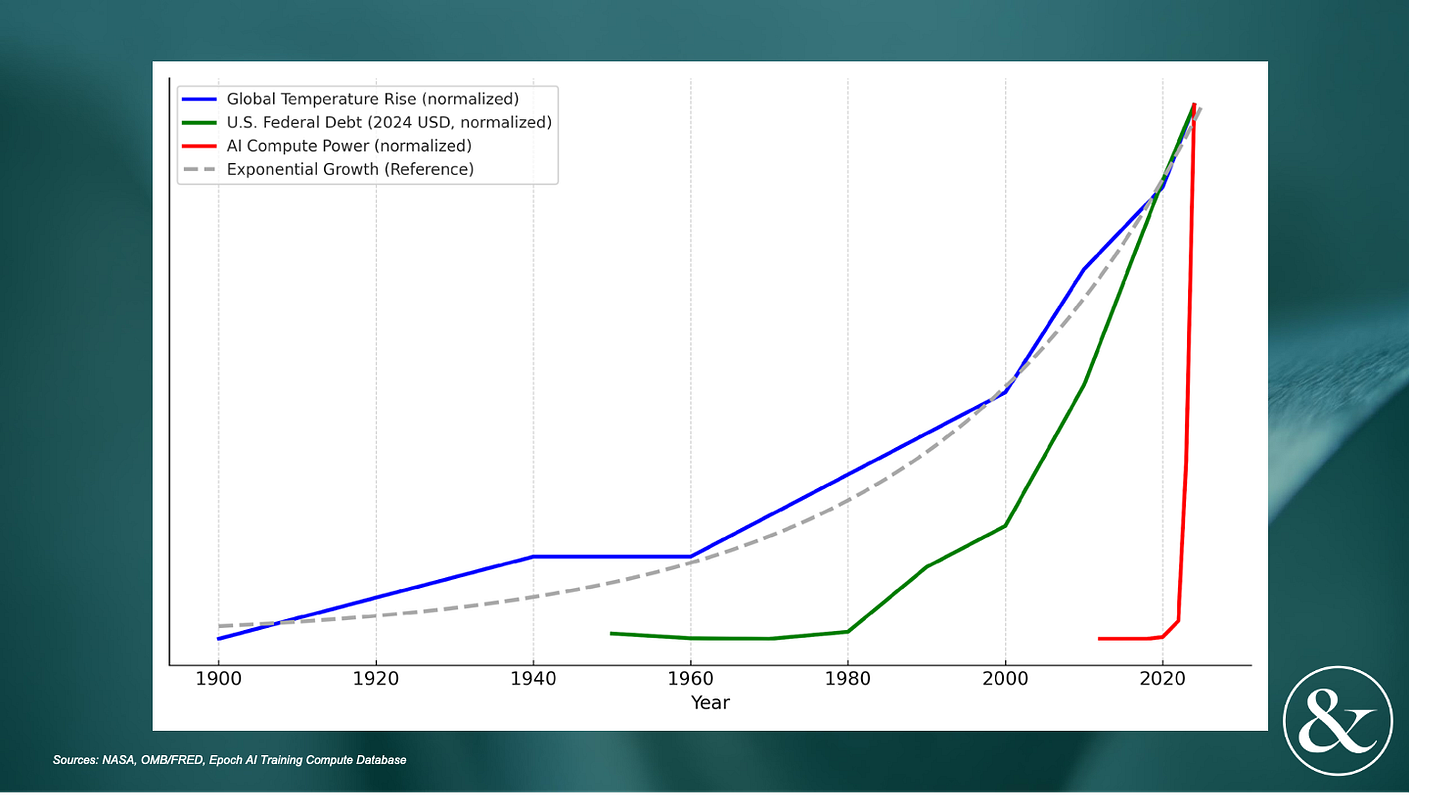
Climate: The planet’s warming rate has accelerated. NASA ranks 2024 as the hottest year on record, and Berkeley Earth now measures warming at roughly a quarter-degree Celsius per decade. Its 2025 report reached a sobering conclusion: the last 3 years broke from the steady line scientists trusted for 50 years, meaning the old graph no longer reliably predicts the future.
Government Policy: The U.S. government’s room to respond keeps narrowing as debt climbs. U.S. national debt passed $39 trillion this summer, up about $2.8 trillion in one year. Interest on that debt now ranks among Washington’s largest expenses, which leaves less room to fund the programs hospitals and clinics rely on.
Technology: The computing power used to train frontier AI models has doubled roughly every six months since 2010, according to Epoch AI. That works out to a ten-billion-fold climb in fifteen years. No earlier technology scaled at anything close to that pace.
Each curve is steep on its own. What’s even more important is what happens when all three land in the same place at the same time.
When the curves converge
Inside that hospital system, all three forces are hitting at once.
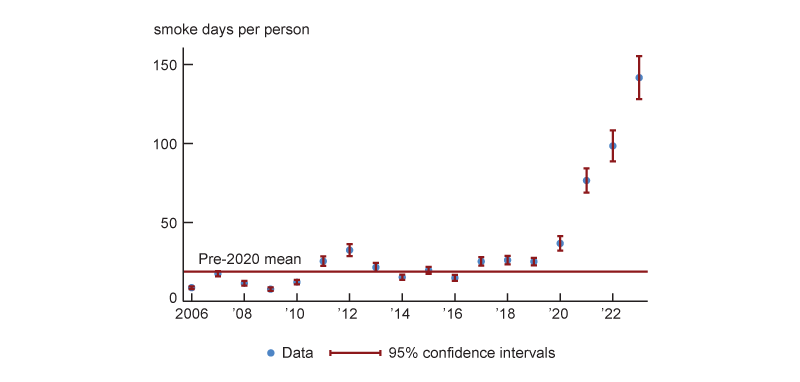
Start with climate. Last week, smoke from Canadian wildfires settled over the eastern half of the country, and more than 100 million Americans woke up under air-quality alerts. Emergency rooms filled with people struggling to breathe. A decade ago, smoke like that reaching the East Coast would have led the national news. Now it arrives most summers. The first great eastern smoke-out came in 2023, and it has returned every year since. See the graph above from the Federal Reserve Bank of Chicago.
Now add policy. The demand spike from that smoke lands at the exact moment federal support is receding. The new federal law cuts roughly $1 trillion from Medicaid over the next decade, and separate reductions to hospital payments already took effect last fall. One watchdog counts more than 400 hospitals at high risk of closing or trimming services. Consequently, more patients arrive through the doors while the dollars supporting each bed thin out.
Then add technology. On top of all of it, these leaders have to decide how to bring AI into clinical care safely and responsibly. Done well, it eases the cost pressure the Medicaid cuts create. Done badly, it puts patients at risk.
That is three accelerating forces landing in one place in a single quarter. A strong team can plan for any one of them. What can be overwhelming is the timing: the next two land before the team has processed the first.
Why these changing forces overload us

Here is the part that matters most for the leaders I spoke to yesterday. Our nervous system was built for a world that changed slowly, not the world we now inhabit.
For nearly all of human history, the environment shifted across generations, not quarters. Our threat response evolved to handle a rare predator and then return to calm. Evolutionary biologists Colin Shaw and Daniel Longman describe the modern result simply: the stress response now fires “as if you’re facing lion after lion,” whether the trigger is a hard conversation or a buzzing phone.
But still, we try to keep up. We run harder and stay later. It’s like we’re at the turn of the 20th century trying to outrun the newly invented car on our horses. The horse is strong and willing, but still no match for the machine. The race is unwinnable, and running it burns the capacity we need to lead.
The move that’s actually available
We cannot slow the curves. To put it in the same terms as last week’s post, scope belongs to the world. What belongs to us is sequence, and the discipline to protect it. That is the third option the Power of &™ opens up: accept the full scope, and control the order and degree to which we meet it.
Last week we sorted the week into four boxes that sort urgency and importance, noting that our leverage sits in Quadrants 1 and 2, the important work, whether or not it carries a deadline. Forces like these are practically built to yank us out of those boxes. Every new shock arrives in a Quadrant 3 costume, loud and urgent, but not necessarily important. Regardless, the new stuff landing in our laps feels like it cannot wait.
Recapturing capacity is how we stay in the boxes that matter. That is the Capacity Advantage: the pause that lets us tell a real Quadrant 1 fire from a Quadrant 3 impostor, even while three curves bend upward around us. We can do anything, but we can’t do everything. So in a world of accelerating change, choosing well beats running hard.
So here is the question I am sitting with this week: which of the three forces is quietly rewriting a plan I already made?
Sources
Climate
NASA GISS, Global Temperature — 2024 hottest year on record: https://science.nasa.gov/earth/explore/earth-indicators/global-temperature/
Berkeley Earth, Global Temperature Report for 2025 — ~0.20°C/decade since 1980, recent acceleration, “past warming rate is no longer a reliable predictor of the future”: https://berkeleyearth.org/global-temperature-report-for-2025/
Wildfire smoke (climate collision)
NBC News, July 17, 2026 — 100M+ Americans under air-quality alerts, Milwaukee to Washington, D.C.: https://www.nbcnews.com/data-graphics/canada-wildfire-smoke-map-2026-us-states-air-quality-health-risks-rcna588051
NPR, July 18, 2026 — smoke over Northeast/Mid-Atlantic/Midwest; “becoming a yearly occurrence”: https://www.npr.org/2026/07/18/nx-s1-5899009/us-canada-wildfire-smoke
Yale E360, June 2023 — the first extraordinary eastern-U.S. smoke event: https://e360.yale.edu/digest/canada-wildfires-smoke-eastern-united-states-satellite-images
Policy / hospital funding (policy collision)
U.S. debt figure — USAFacts (~$39.5T, June 2026): https://usafacts.org/answers/how-much-debt-does-the-us-have/country/united-states/
JEC Monthly Debt Update (July 2026): https://www.jec.senate.gov/public/index.cfm/republicans/2026/6/national-debt-reaches-39-20-trillion-increased-2-99-trillion-year-over-year-increased-10-94-trillion-in-five-years
NBC News / Public Citizen, Apr 2026 — 446 hospitals at high risk; law cuts ~$1T from Medicaid over a decade: https://www.nbcnews.com/health/health-news/medicaid-cuts-threaten-hundreds-hospitals-new-report-finds-rcna265789
Medstates, Mar 2026 — DSH hospital payment cuts (~$8B/yr) took effect Oct 1, 2025: https://www.medstates.com/medicaid-funding-cuts/
Becker’s, May 2026 — HR 1 ~$1T Medicaid cut; Michigan (Hillsdale) hospital CEO on the strain: https://www.beckershospitalreview.com/finance/we-cannot-cut-our-way-to-success-hospitals-prep-for-medicaid-crunch/
Technology (AI compute + tech collision)
Epoch AI — training compute doubling ~every six months since 2010, ~10-billion-fold: https://epoch.ai/data-insights/compute-trend-post-2010
Vector Institute, May 2026 — physician AI adoption projected to surpass 80% by 2026; Stanford review of 500+ medical AI studies (only 5% used real clinical data): https://vectorinstitute.ai/a-strategic-blueprint-for-safe-health-ai-implementation-your-2026-roadmap/
URAC, Jan 2026 — governance and trust as the 2026 theme; innovation moving faster than regulation: https://www.urac.org/blog/health-care-ai-in-2026-governance-and-trust-take-center-stage/
Evolutionary mismatch / nervous system
Shaw & Longman via ScienceDaily, Dec 2025 — stress response fires “as if you’re facing lion after lion”: https://www.sciencedaily.com/releases/2025/12/251207031335.htm (fuller quote: https://www.thebrighterside.news/post/life-may-be-reshaping-our-bodies-and-brains-faster-than-evolution-can-handle/)
Yong & Chan, Behavioral Sciences (2026) — modern life outpacing the human mind: https://phys.org/news/2026-07-modern-life-outpacing-human-mind.html